News, Archives and Photos for the Florence Flood of 1966
Florence-Flood.com is a website, blog and information resource dedicated to the tragic Florence flood of November, 1966. If you have a resource about the flood you would like to see listed here, please let us know. You can also ask questions and/or leave comments on all of the articles using the comment form at the bottom of each post, or sign up to receive email alerts when we update the site by using the form below.
Enter your email address to join our notification list:
January 14, 2008
Scholarly Articles about the Arno Flood of 1966
Google Scholar is a specialized search engine from Google that searches scholarly texts, professional journals, research papers, etc. Here is a search for the 1966 Florence Flood. This is a pretty interesting resource but unfortunately it seems that most of this material must be paid for to actually view in its entirety, on the sites listed by Google Scholar all you get are abstracts (mostly). Still - it is a good starting place to at least find relevant materials, titles, etc.
This is an interesting clip from YouTube that is a mix of some contemporary docudrama looking stuff mixed in with some vintage film of the 1966 flood and work of the mud angels. I am not sure where it was taken from. If you can shed some light on the origins of this please let me know in the comments.
Here is a post on a message board that has several good black and white photos of the flood - I don't know about the copyright of these images, some of which seem familiar. There are a couple by the train station and the SITA station I have not seen before though.
Here is some footage (1:42) of the Piazza Signoria on the night of the 40th anniversary of the flood. You can see the slideshow in the loggia and the purple lighting, etc. It was a very moving exhibit. We were there that night but only have still images.
The "The Years of the Cupola" is a digital archive of all the works belonging to the Opera di Santa Maria del Fiore relating to Brunelleschi's Dome. Of course, that means work damaged by the flood of 1966:
"The project to make images of the archival material contained in The Years of the Cupola available in Internet is a response to the challenge posed by the state of conservation of the original manuscripts, so damaged after the 1966 flood that traditional photography alone would be of limited usefulness for the reading of the faded script. The project presents both photography carried out before the flood, when available, and new images processed through techniques of "virtual restoration," in such a manner as to distinguish visual tools for reading from evidence of the current appearance of the leaves. Effort has been made to render the relationship between the various types of photography presented by the project as intuitive as possible.
This is an amazing project (and website) and should be a great source for scholars.
Here is a really interesting resource - a video on the restoration of books immediately after the flood:
Originally produced by the Royal College of Art, London, 1968.
Book conservators begin to restore the many books damaged by the devastating flood in Florence, Italy in 1966. Peter Waters covers a book in leather. Christopher Clarkson makes a velum binding.
This video is made available from the University of Utah. Hat tip to PhiloBiblos
November 4th, 2006 40th Anniversary of the Florence Flood
On Saturday Florence was buzzing with various exhibits, memorials and events surrounding the remembrance of the flood. Many shops had their own photos up in their windows, which was very interesting since many of the pictures are originals and not the shots you see over and over again in books and old postcards. The lavanderia on Via dei Neri had several interesting photographs, including one of the street decorated for Christmas that year - Christmas 1966 in Florence must have been a pretty somber event.
There was a mass at Santa Maria del Fiore, and a special exhibit by David Lees, a photographer for Life magazine at the time of the flood, opened in the Palazzo Vecchio. This exhibit is very moving and very well presented - I will be going back again before it closes.
At night, the banks of the Arno were lit, as were the bridges. The Ponte Vecchio and Ponte alle Grazie were bathed in a eerie purple light, and there were fog machines on the banks of the river producing a mysterious effect.
The Palazzo Vechhio and most of the statues in the Piazza Signoria and the Loggia dei Lanzi also had the purple light effect, while in the loggia itself there were video and slide presentations with scenes of the flood and the clean up efforts, set to some moody, techno-type music.
This is really just a cursory review of some of the things that happened on Saturday - there was also a large exhibit in Piazza Santa Croce of all the civil services, and there were speeches on the steps of the Palazzo Vechhio, as well as a full day itinerary that took place inside during the day for Mud Angels, etc. We'll keep posting news and updates as we here about things.
Today is the day, 40 years ago, when the city of Florence awoke to a terrible deluge:
Mud Angels swarmed to city in '66 to save priceless heritage
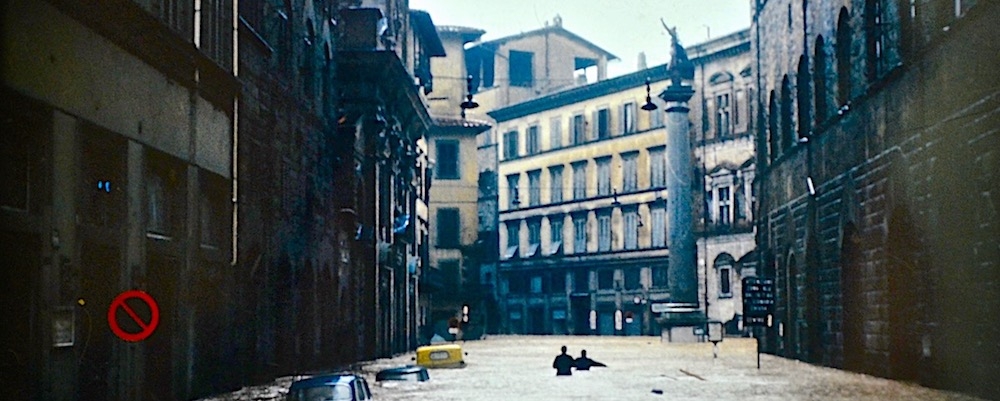
(ANSA) - Florence, November 1 - At 5am on November 3, 1966 the skies over Tuscany opened and poured non-stop for 18 hours, causing an unprecedented artistic, economic and human disaster. The River Arno burst its banks, flooded the city and claimed 29 lives.
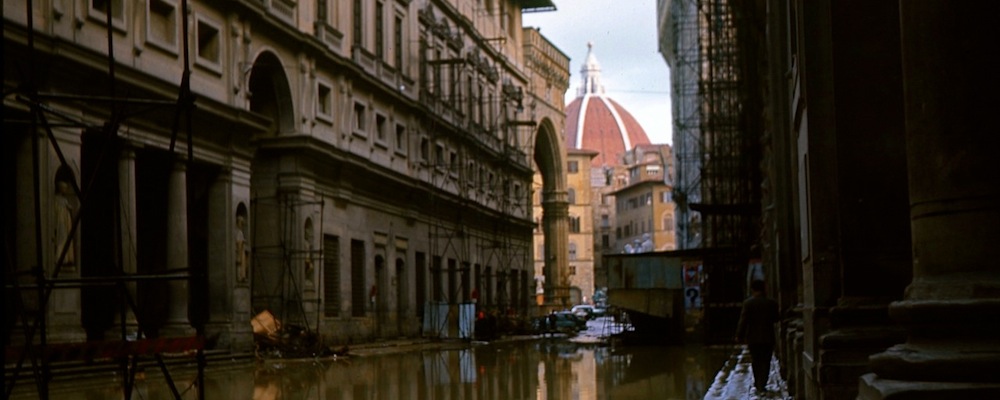
Mud and water swamped the museums, churches and libraries of the birthplace of the Renaissance, ruining many great works.
The damage caused was incalculable. But it was a fraction of the devastation the city would have suffered without the efforts of thousands of young volunteers who came from all over Italy and from abroad to save the art treasures and help Florence off its knees.
This week Italy is recalling the disaster and the efforts of those volunteers, nicknamed the 'mud angels', who did so much to limit its impact.
Over 2,000 of them are returning here to take part in some of the 100 events marking the 40th anniversary of the flood. These include a mass in Florence's Duomo in honour of the victims, which US Senator Ted Kennedy and Culture Minister Francesco Rutelli will attend on November 4. There are a number of concerts and exhibitions, including a show at Palazzo Vecchio of shots of the wreckage and the rescue work by Life magazine photographer David Lees.
All week Italian television has been broadcasting reports and documentaries remembering the events of 40 years ago.
One of the most fascinating clips features British actor Richard Burton making a public appeal for help. He made the appeal in perfect Italian, even though he could not speak the language, brilliantly repeating lines he had been drilled. "Florence needs us all because she belongs to the world," said Burton, who was in Italy with Elizabeth Taylor, his wife at the time. "Everything we can do, we will do, so that this city, which we all need so much, comes back to us".
Burton was also the narrator of a documentary on the disaster by Florentine film and theatre director Franco Zeffirelli, which will be screened here on November 5.
Zeffirelli said that November 4 1996 was a "very happy date" for him.
"It seems a crazy thing to say but on that day I was witness to an incredible Florence," Zeffirelli added.
"In a situation of extreme hardship, the Florentines threw themselves into the mud to put the city back on its feet.
"It shows how a city can pick itself up from a horrendous situation".
Among the masterpieces to be saved by the mud angels was the wooden Crucifixion by Florentine painter Cimabue (1240-1302), considered the last great artist of the Byzantine tradition. Experts managed to restore the priceless work, even though the fury of the flood water which swept into the Basilica di Santa Croce had wiped off most the paint. Another illustrious local, Wanda Ferragamo - the wife of celebrated footwear designer Salvatore Ferragamo and the president of the company he set up - also remembers the flood well.
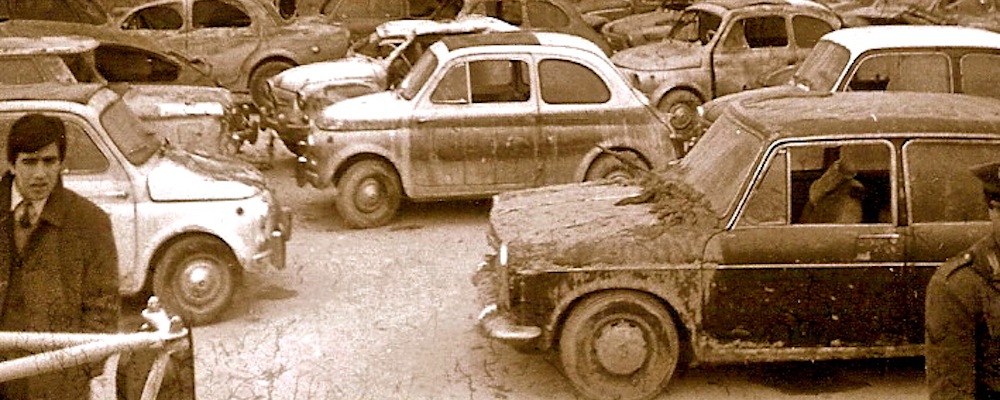
"The power of the water was so strong that it swept away everything in its path and our company s shoes were found kilometres away days later," she said. "Ours was not an isolated case. The city's shopkeepers wept that day, when the Arno seemed to have taken away the future. Many people cried, but not in front of the TV cameras. "Rather than wasting time complaining, all the Florentines rolled up their sleeves, showing strength of spirit, solidarity, civic responsibility and, above all, love for the city".
Flood protection of the historic centre of Florence, which was declared a UNESCO World Heritage Site in 1982, has since been beefed up by a series of dams, civil-engineering projects and the construction of higher embankments in the city.
But experts warn that more still needs to be done to make the city and the surrounding area totally flood-proof.
The Florentine is Florence's English language "newspaper". It is published every two weeks and can be (at times) a great resource for the English speaking community. They have a special issue out devoted to the flood which is quite well done - stories, photos, letters written at the time, etc. Unfortunately all they have on-line is a few sample pages - in PDF format (I would really love to see them develop their website more fully).
The Comune, along with the offices of the Regione Toscana and the Provincia di Firenze have published a booklet of events surrounding the anniversary of the flood. The PDF file (Italian only) is here. There are dozens of things happening, including a full slate on November the 4th at the Palazzo Vecchio. Below is the cover image.
The Kunsthistorisches Institut in Florenz (German Art History Library) has a new site up with an exhibition of the flood. There are some very moving images of the town, and of specific buildings and works of art.
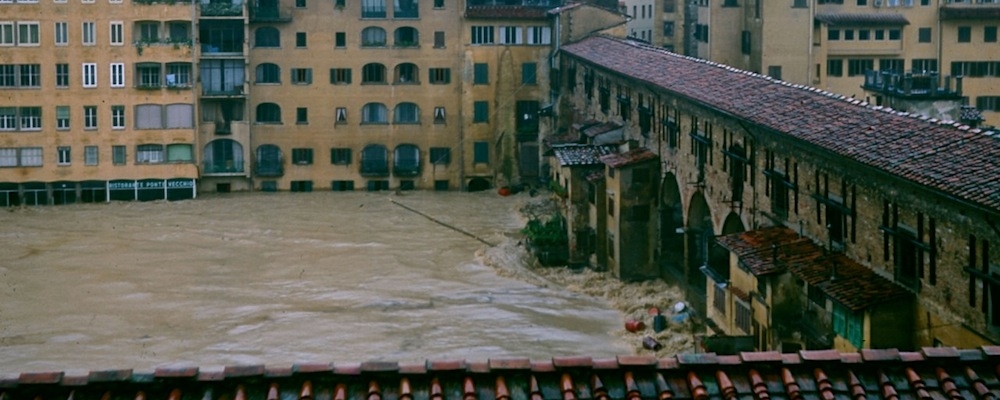
Due to its geographical location, Florence has often been the victim of flooding. In more recent years, the 1844 flood has left a particularly lasting memory, even though the peak of the flooding remained significantly below the peak recorded on November 4, 1966. The photographs taken in these dramatic circumstances serve as silent but impressive witnesses of the history of Florence. The staggering damage to the famous Ponte Vecchio illustrates the extent of the flood catastrophe.
Thanks to Alexandra in the comments for letting us know about this.
Americans Who Helped in the Florence Flood Rescue Effort
This article is about 10 years old, but contains some good facts about people coming to Florence to help with the clean up and restoration:
On arriving in Florence, he was astounded by the immensity of the task. Something like a million books from the BNC alone, including hundreds of thousands of old and rare books, had been damaged by the flood. Although all the books had been dried by early 1967, he estimated that it would take a staff of about 100 working on book restoration for another 20 years at the Library just to undo the worst of what the Arno River had done in minutes.
That was a conservative estimate, as they are still restoring books 40 years later!
I have been having a hard time finding news about upcoming events for the 40th anniversary of the flood but stumbled on one this morning:
New York University’s Conservation Center of the Institute of Fine Arts, and Villa la Pietra, NYU’s 57-acre campus in Florence, in a joint American-Italian venture with Mayor Leonardo Domenici of Florence and the Opificio delle Pietre Dure e Laboratori di Restauro will mark the 40th anniversary of the Florence Flood with an international symposium to be held in Florence, Italy. Entitled Conservation Legacies of “l’Alluvione,” the event will take place at the Villa la Pietra and the Palazzo Vecchio on November 10 and 11, 2006, and feature a keynote address by Senator Edward M. Kennedy.
On Saturday, November 11, Mayor Domenici, along with U.S. Senator Edward M. Kennedy and the mayors of New Orleans, Dresden, and Prague-cities that have experienced severe flooding-will sign a Declaration of Commitment to conservation and protection of art treasures in the wake of natural disasters. For a detailed program of events, visit: www.nyu.edu/gsas/dept/fineart/ifa/Florence/florence.htm.
Mega.it has a special section with photos of the flood, captioned in English. Not the most user friendly page, and the photos are not that large, but still a good resource.